Motivation
Every New Year’s Eve in Korea, people gather at midnight to hear the ceremonial temple bell struck 33 times (제야의 종). Its deep reverberations are believed to wash away the burdens of the passing year and usher in renewed peace and hope.
Temples’ ambient sounds and resonant bells have always brought me immense calm. In this project, I aimed to simulate the acoustic signature of the most celebrated Korean temple bell — the Sacred Bell of King Seongdeok (성덕대왕신종) — driving the synthesized audio directly from its physical geometry, material properties, and 3D listener positions.
At the end of the video, the Buddha shines brightly, representing 광명 (Gwangmyeong, 光明) — the light of wisdom emanating from a Buddha or Bodhisattva, symbolizing the power to wash away the darkness and worldly suffering. Through this project, I hope to share that experience — transferring a bright and tranquil state of mind to everyone who listens. 🪷
“그것을 본 자는 기이하다고 칭송하고 그것을 들은 자는 복을 받았다.”
“Those who saw it praised its wonder, and those who heard it were blessed.”
— Inscription on the Sacred Bell of King Seongdeok (성덕대왕신종 명문, 771 CE)
Background
The Sacred Bell of King Seongdeok, made in 771 CE, has a big cultural and historical significance in Korea. Therefore, the bell has been closely studied, and many attempts were made to recreate the sound through scientific approaches. The regular bell striking ceremony has stopped in 1992 to prevent further damage to the artifact.
As heard in this recording, the sound exhibits several defining acoustic characteristics:
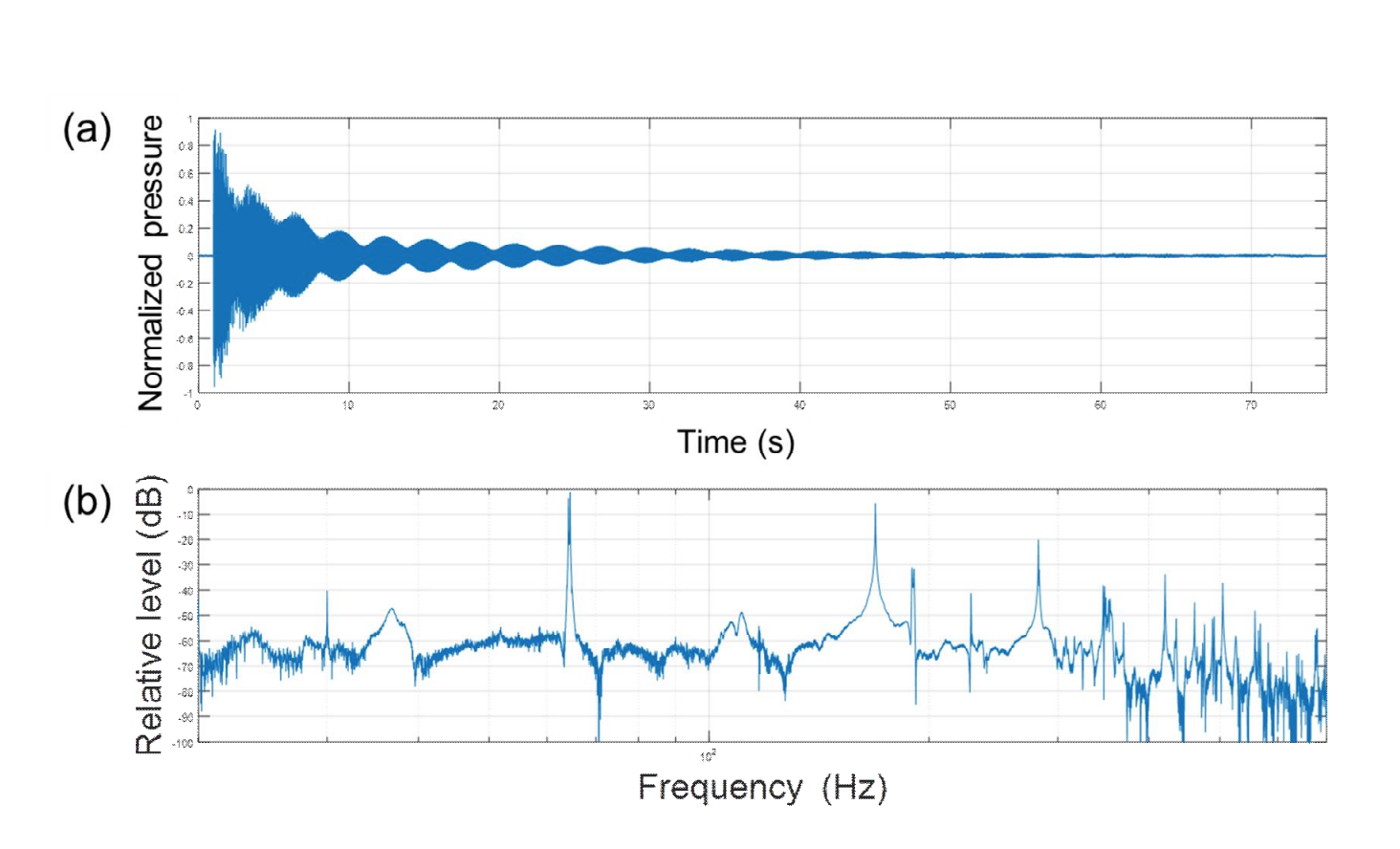
- Two Main Frequencies: The hum tone (\(64\ \text{Hz}\)) and the fundamental tone (\(168\ \text{Hz}\)) make up the body of the sound. The fundamental tone has a shorter decay time around 20s, while the hum tone has a long decay up to 2 minutes.
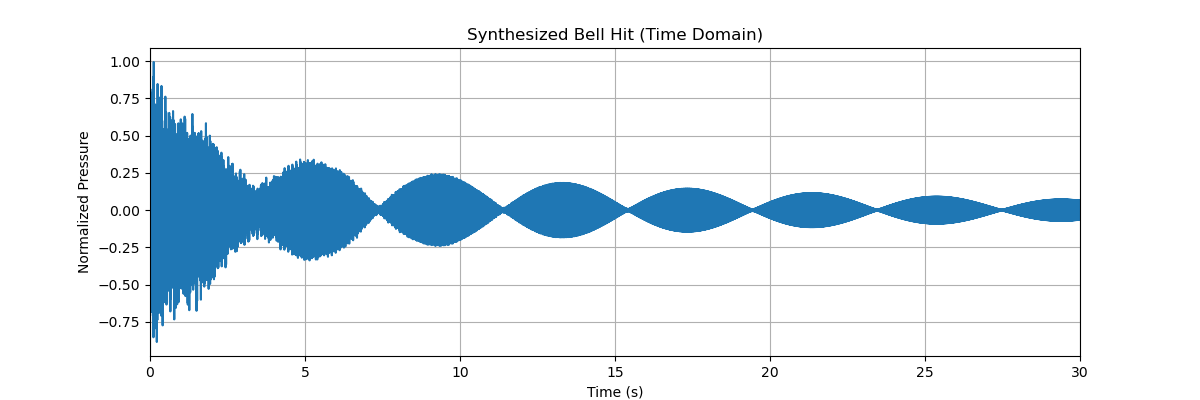
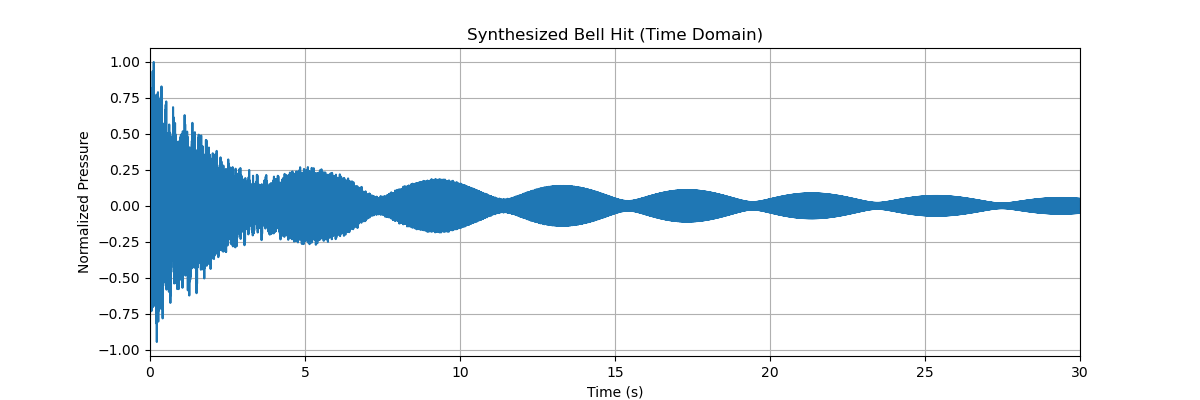
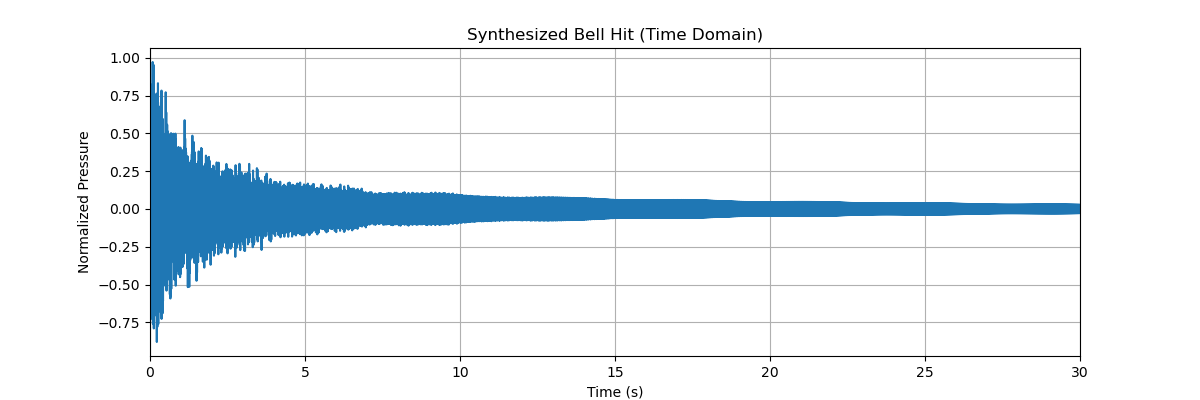
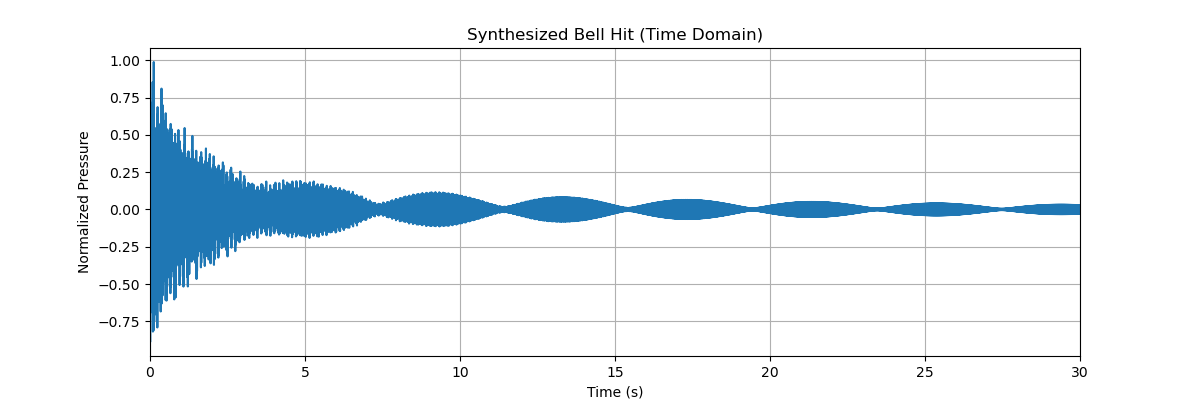
- The Beating Phenomenon (맥놀이): Subtle structural and thickness asymmetries create closely spaced pairs of eigenfrequencies, producing ringing sounds that fade in and out periodically. The hum tone has a 3s interval, while the fundamental tone has a 9s interval.
- The Acoustic Sound Pipe (음통): A hollow pipe at the top is designed to absorb high frequencies above 300 Hz, leaving only a deep low-frequency reverberation.
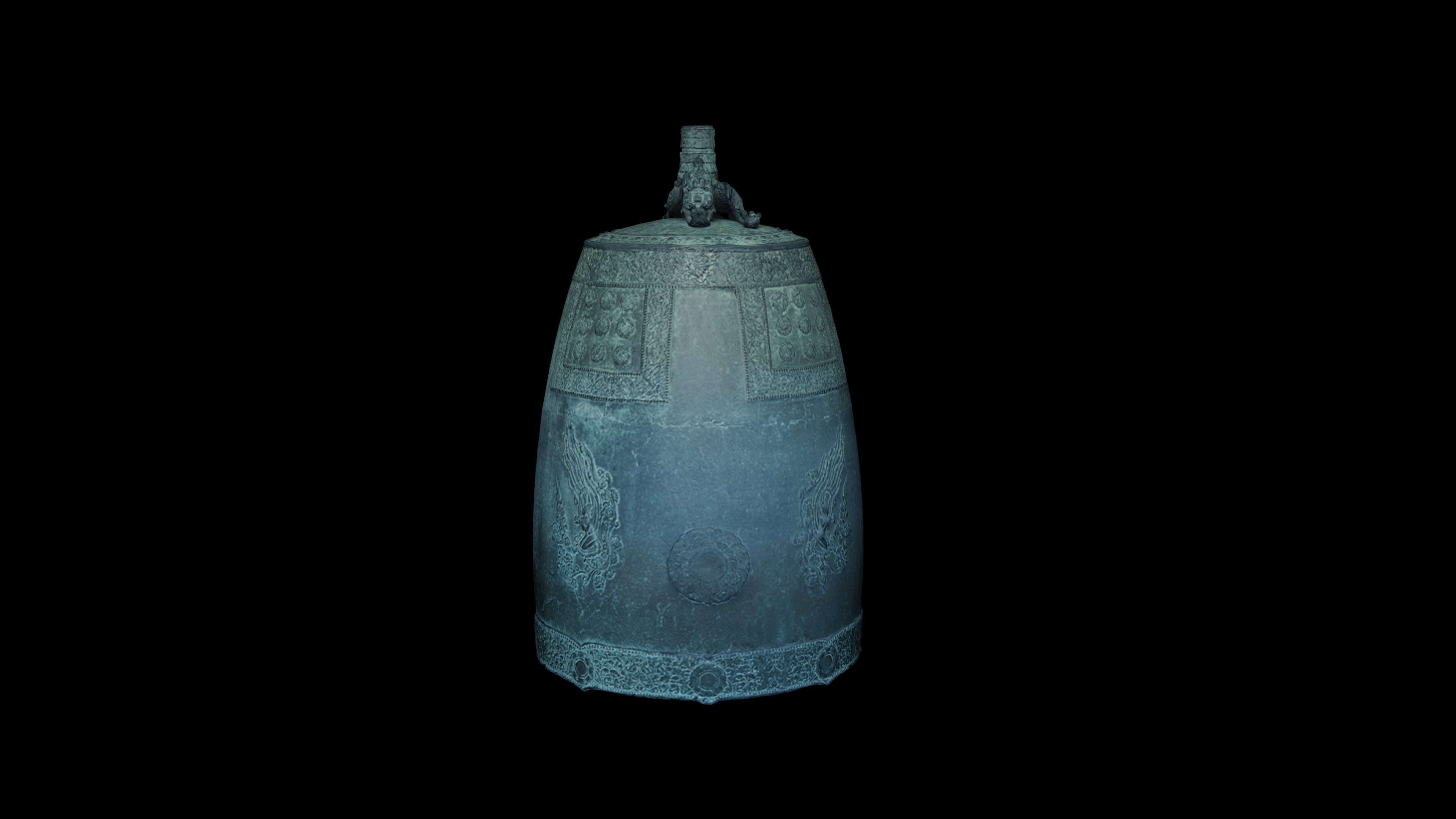
The end goal was to match these characteristics as closely as possible, given the mesh and bell properties.
Technical Details
1. Modal Analysis using Finite Element Method (FEM)
The bell geometry was tetrahedralized to perform modal analysis. Using material parameters for a similar bronze bell (mass density \(\rho = 8800\ \text{kg/m}^3\), Poisson ratio \(\nu = 0.34\), and Young’s Modulus \(E = 79\ \text{GPa}\)), mass and stiffness matrices were assembled:
- Mass Matrix (\(\mathbf{M}\)): Formed by integrating volume density per tetrahedron, distributing the element mass to the four vertices, and assembling into a global sparse matrix.
- Stiffness Matrix (\(\mathbf{K}\)): Assembled from element stiffness matrices
\(\mathbf{K}_e = \mathbf{B}^T \mathbf{C} \mathbf{B} \cdot V\) for each tetrahedron:
- Constitutive Matrix (\(\mathbf{C}\)): A \(6 \times 6\) elasticity matrix derived from Hooke’s law relating 3D stress to strain (\(\mathbf{\sigma} = \mathbf{C} \mathbf{\epsilon}\)) via Young’s Modulus (\(E\)) and Poisson’s ratio (\(\nu\)): $$\mathbf{C} = \frac{E}{(1+\nu)(1-2\nu)} \begin{bmatrix} 1-\nu & \nu & \nu & 0 & 0 & 0 \\ \nu & 1-\nu & \nu & 0 & 0 & 0 \\ \nu & \nu & 1-\nu & 0 & 0 & 0 \\ 0 & 0 & 0 & \frac{1-2\nu}{2} & 0 & 0 \\ 0 & 0 & 0 & 0 & \frac{1-2\nu}{2} & 0 \\ 0 & 0 & 0 & 0 & 0 & \frac{1-2\nu}{2} \end{bmatrix}$$
- Strain-Displacement Matrix (\(\mathbf{B}\)): A \(6 \times 12\) matrix composed of four \(6 \times 3\) submatrices \(\mathbf{B} = \begin{bmatrix} \mathbf{B}_1 & \mathbf{B}_2 & \mathbf{B}_3 & \mathbf{B}_4 \end{bmatrix}\) relating nodal displacements to internal strain (\(\mathbf{\epsilon} = \mathbf{B}\mathbf{u}_e\)): $$\mathbf{B}_i = \begin{bmatrix} \frac{\partial N_i}{\partial x} & 0 & 0 \\ 0 & \frac{\partial N_i}{\partial y} & 0 \\ 0 & 0 & \frac{\partial N_i}{\partial z} \\ 0 & \frac{\partial N_i}{\partial z} & \frac{\partial N_i}{\partial y} \\ \frac{\partial N_i}{\partial z} & 0 & \frac{\partial N_i}{\partial x} \\ \frac{\partial N_i}{\partial y} & \frac{\partial N_i}{\partial x} & 0 \end{bmatrix}$$ where \(\nabla N_i = \left(\frac{\partial N_i}{\partial x}, \frac{\partial N_i}{\partial y}, \frac{\partial N_i}{\partial z}\right)\) are the constant spatial gradients of the linear shape functions.
- Generalized Eigenvalue Problem: Solved for natural frequencies \(f_i =
\frac{\omega_i}{2\pi}\) and mode shapes \(\mathbf{\phi}_i\):
$$\mathbf{K}\mathbf{\phi}_i = \omega_i^2 \mathbf{M}\mathbf{\phi}_i$$
The first six 0 Hz rigid-body modes were discarded to model the free-hanging pivot condition.
Natural frequencies \(\omega_i\) define the distinct acoustic pitches (e.g., hum and fundamental tones), while mode shapes \(\mathbf{\phi}_i\) dictate strike-location excitation strengths and direction (\(A_i \propto \mathbf{\phi}_i^T \mathbf{f}\)), used in acoustic radiation modeling via ESM/BEM.
2. Modal Damping & Sound Synthesis
Because real bells exhibit frequency-dependent energy dissipation rather than uniform Rayleigh damping, individual damping ratios (\(\zeta_i\)) were calibrated from historical \(T_{60}\) reverberation measurements (\(e^{-\zeta \omega T_{60}} = 10^{-3}\)):
- Hum Tone (64 Hz doublet): \(\Delta f \approx 0.34\ \text{Hz}\), \(\sim 3\ \text{s}\) beating interval, \(\zeta = 0.00013\), audible for over 60 seconds.
- Fundamental Tone (168 Hz doublet): \(\Delta f \approx 0.13\ \text{Hz}\), \(\sim 9\ \text{s}\) beating interval, \(\zeta = 0.00030\), persisting for ~20 seconds.
- Modal Superposition: Time-domain audio was synthesized by summing the decaying sinusoidal responses: $$y(t) = \sum_{i} A_i e^{-\zeta_i \omega_i t} \sin(\omega_i t + \theta_i)$$
- Empirical Decay Tuning (\(T_{60}\) Curve): To realistically tune modal damping across all
frequencies, decay times were interpolated from measured and calibrated Korean Beomjong anchors:
- Anchor Frequencies:
anchors_f = [64.0, 168.0, 300.0, 500.0, 1000.0, 2000.0] # Hz - Decay Times:
anchors_t60 = [132.0, 20.0, 8.0, 4.0, 1.2, 0.15] # seconds
np.interp) and converted into individual modal damping ratios (\(\zeta_i\)) for each eigenfrequency. - Anchor Frequencies:
3. Acoustic Transfer: Boundary Element Method (BEM) vs. Equivalent Source Method (ESM)
While modal analysis computes how the bell structure vibrates, acoustic transfer calculates how those surface vibrations radiate outward through air into 3D space. Both BEM and ESM solve for the complex acoustic pressure amplitude and Sound Pressure Level (SPL in dB) at specific 3D listening positions \(\mathbf{r}_{\text{listen}}\) for each individual modal frequency \(f_i\), accounting for distance attenuation, spatial directivity, and listener orientation:
- BEM (bempp-cl) & Green's Functions:
The Boundary Element Method relies on free-space Green’s functions, treating every individual triangle on
the surface mesh (10K vertices / 60K triangles) as a radiating point source of outward acoustic waves.
- Convergence Failure: At higher modal frequencies, standard exterior boundary integrals break down due to fictitious interior resonance—where the solver gets confused by sound waves bouncing inward inside the hollow bell. While the hypersingular Burton-Miller formulation addresses this problem, assembling its dense matrices took hours per solve and struggled to converge.
- Hardware Limitations: Accelerating dense matrices via the Fast Multipole Method (FMM) or time-domain wave solvers (e.g., Wave-Blender / FDTD) required dedicated GPU acceleration or library dependencies that were difficult to build on a corporate laptop.
- Equivalent Source Method (ESM) Implementation:
To overcome BEM's bottlenecks, ESM replaces the expensive boundary equations with a fast approximation:
- 1. Place Virtual Sound Emitters Inside the Bell: A set of proxy sound sources is placed slightly inside the bell's interior (retracted \(5\text{ cm}\) inward from the surface vertices).
- 2. Match Surface Vibrations: The sound produced by all internal emitters must match the bell's known vibration velocity \(\mathbf{v}\) at the outer surface: $$\mathbf{A} \mathbf{q} = \mathbf{v}$$ where \(\mathbf{A}\) is the transfer matrix mapping each emitter to the surface, and \(\mathbf{q}\) represents the unknown emitter strengths.
- 3. Solve Emitter Strengths: The emitter strengths \(\mathbf{q}\) are solved directly using regularized least squares: $$\mathbf{q} = (\mathbf{A}^H \mathbf{A} + \lambda \mathbf{I})^{-1} \mathbf{A}^H \mathbf{v}$$ where \(\mathbf{I}\) is the identity matrix and \(\lambda\) is a small damping parameter that ensures numerical stability during matrix inversion. This direct linear solve avoids convergence stalls and takes only seconds per frequency.
- 4. Evaluate Sound at Any Listener Position: Once the emitter strengths \(\mathbf{q}\) are known, the sound pressure at any 3D listener position is computed by summing the wave contributions from all internal emitters: $$p(\mathbf{r}_{\text{listen}}) = \sum_{j} q_j \frac{e^{ik R_j}}{4\pi R_j}$$ where \(R_j = \|\mathbf{r}_{\text{listen}} - \mathbf{r}'_j\|\) is the distance from the \(j\)-th emitter to the listener, \(k = \omega/c = 2\pi f / c\) is the acoustic wavenumber, and \(i = \sqrt{-1}\) is the imaginary unit encoding the wave's phase delay. The Sound Pressure Level (SPL in dB) is then directly evaluated from \(p\).
4. Acoustic Radiation Visualization
The sound field was visualized in 3D using the Houdini CHOP node and the audio from modal sound synthesis. Based on the amplitude, the particle birth rate and particle velocity were controlled, so the beating effect can be clearly visualized.
Experimenting Beat Patterns with Acoustic Transfer
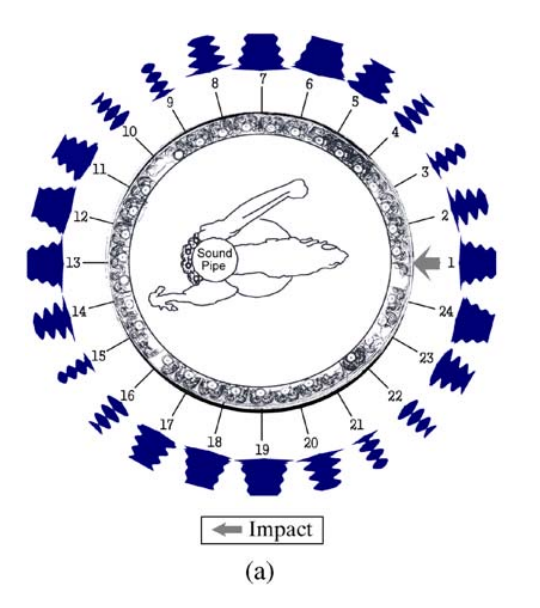
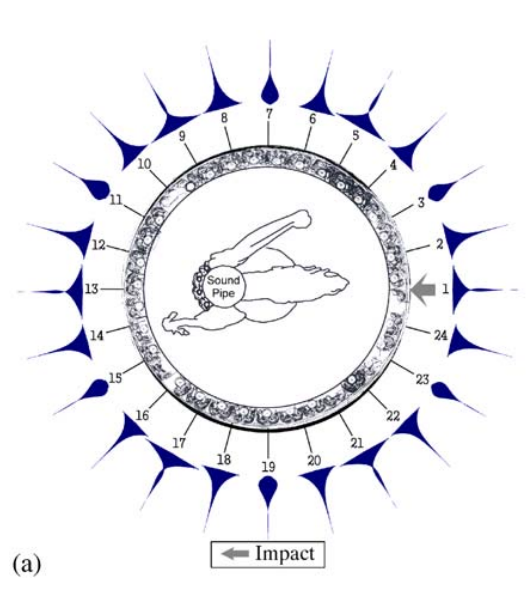
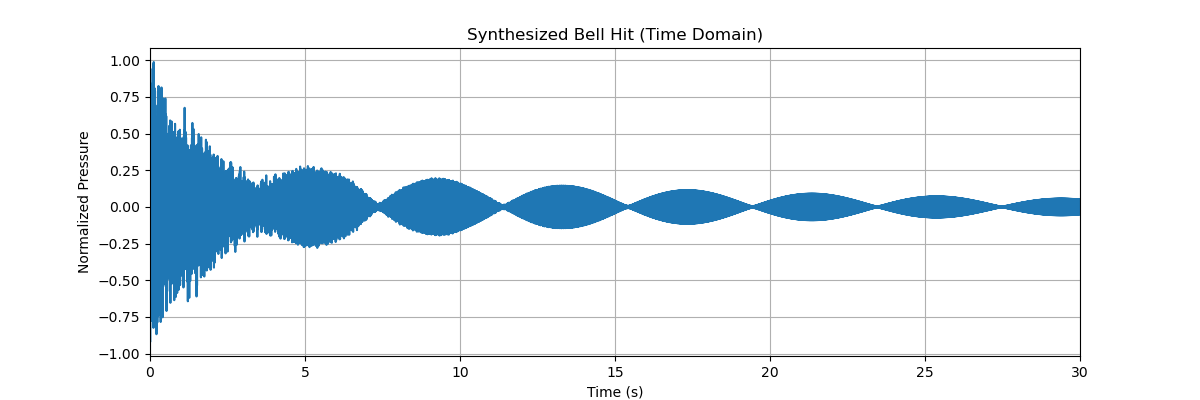
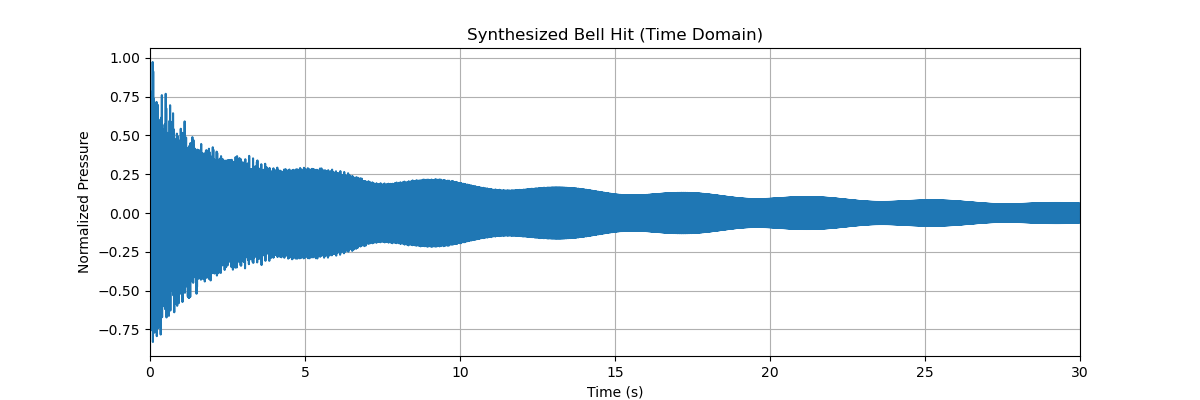
The paper [3] demonstrates that the bell's beating pattern differs based on the listener's spatial location. I evaluated whether varying listener angles reproduced these spatial beating variations using acoustic transfer.
While differences in beating strength across azimuth angles were observable, the pattern did not fully match the empirical maps documented in the reference papers.
1. Reference Paper Characteristics
| Metric | Hum Tone (64 Hz) | Fundamental Tone (168 Hz) |
|---|---|---|
| Beat Pattern |
|
|
| Prominent Angles | \(30^\circ, 45^\circ\) | \(0^\circ, 30^\circ, 60^\circ, 90^\circ\) |
| Unclear Angles | \(0^\circ, 90^\circ, 180^\circ\) | \(15^\circ, 45^\circ, 75^\circ\) |
| Spatial Periodicity | Positions spaced \(\sim 90^\circ\) apart | Positions spaced \(\sim 30^\circ\) apart |
2. Beat Pattern from My Synthesized Audio
| Angle | Beat Pattern from Synthesized Audio |
|---|---|
| \(0^\circ\) (Baseline) |
|
| \(15^\circ\) |
|
| \(30^\circ\) |
|
| \(45^\circ\) |
|
| \(60^\circ\) |
|
| \(90^\circ\) |
|
Future Work
- Try Wave Blender: An open-source, GPU-accelerated wave acoustics simulator that uses Finite-Difference Time-Domain (FDTD) methods to directly solve the time-domain wave equation in 3D grids.
References
- [1] Doug L. James, Jernej Barbič, and Dinesh K. Pai. 2006. Precomputed acoustic transfer: output-sensitive, accurate sound generation for geometrically complex vibration sources. ACM Transactions on Graphics (SIGGRAPH '06), 25(3), 987–995.
- [2] Doug L. James and Jernej Barbič. 2016. Physically Based Sound for Computer Animation and Virtual Environments: Modal Vibration. ACM SIGGRAPH 2016 Courses.
- [3] S. H. Kim, C. W. Lee, and J. M. Lee. 2005. Beat characteristics and beat maps of the King Seong-deok Divine Bell. Journal of Sound and Vibration, 281(1–2), 21–44.
- [4] Yeon Mi Kim and Sungeun Lee. 2025. Acoustic Analysis of the Sacred Bell of King Seongdeok and the Utilization of Digital Sound Sources. The International Archives of the Photogrammetry, Remote Sensing and Spatial Information Sciences (30th CIPA Symposium), XLVIII-M-9-2025, 735–740.
- [5] J. M. Lee, S. H. Kim, S. J. Lee, and H. G. Choi. 2002. A Study on the Vibration Characteristics of a Large Size Korean Bell. Journal of Sound and Vibration, 257(4), 779–790.
- [6] Wan-Ho Cho, In-Jee Jung, Jung-Han Woo, Bong-Ki Kim, and Jeong-Guon Ih. 2023. Reconstruction of the Spatial Radiation Characteristics of Large Korean Bell. 10th Convention of the European Acoustics Association (Forum Acusticum 2023), 2857–2860.
- [7] Korea Heritage Service (KHS). Bell of King Seongdeok. Sketchfab 3D Model.